Personal build · Live
An inventory and profit system for a one-man mower flipping operation.
My husband has a very white-collar job and a very blue-collar hobby. When restoring his vintage Mustang stopped scratching the itch, he found something more niche: buying tired Honda walk-behind mowers, bringing them back, and selling them on. Mower Ledger tracks every mower, every part and every sale, and says exactly what each one made.
I built it in an evening, as a surprise, to work through a real product end to end: a messy problem, a data model, real infrastructure, and a design language with a point of view.
Try the demo, with sample mowers
The problem
He knew what each one made, but only in his head. Parts come from Honda in bulk, 20 air filters at a time, so the true cost of any single repair was spread across packs, receipts and memory.
- Bulk buying hides the real cost. An $85 pack of filters isn't the cost of any one mower, so per-mower profit was always an estimate.
- Reseller apps are built for something else. The category tracks items bought and sold as-is. None are built around repairing an item with stock bought in bulk.
- The whole picture lived nowhere. What went into each mower, what's still on the shelf, and whether the hobby pays for itself.
The core idea
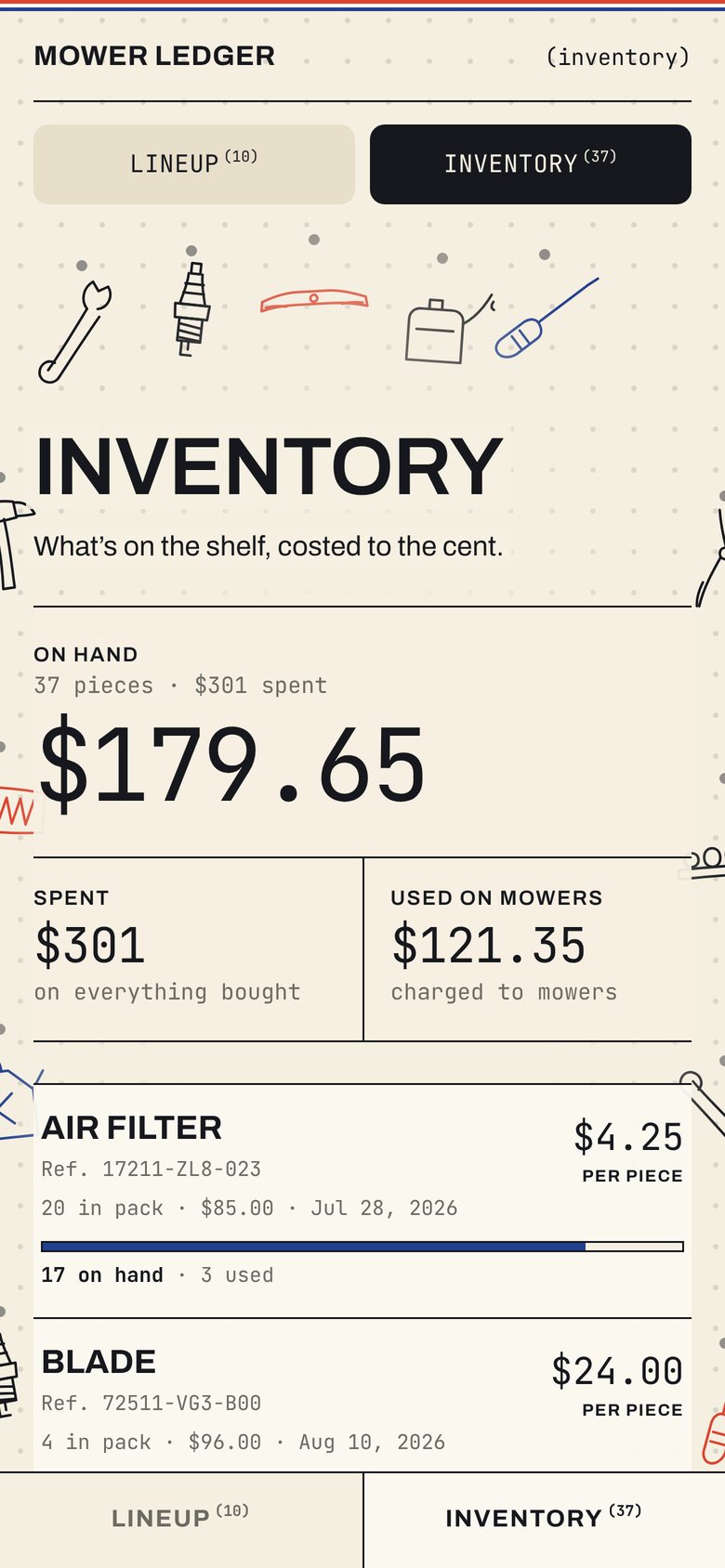
This looked like a notes problem but is really a cost-allocation problem. Bulk parts are inventory, an asset on a shelf, with a per-piece cost: $85 for 20 filters is $4.25 each. The moment a job uses one, $4.25 is charged to that mower and the shelf count drops by one. Profit per mower becomes exact without anyone doing math, and unused stock never makes a sale look worse than it was.
How it works
The lineup
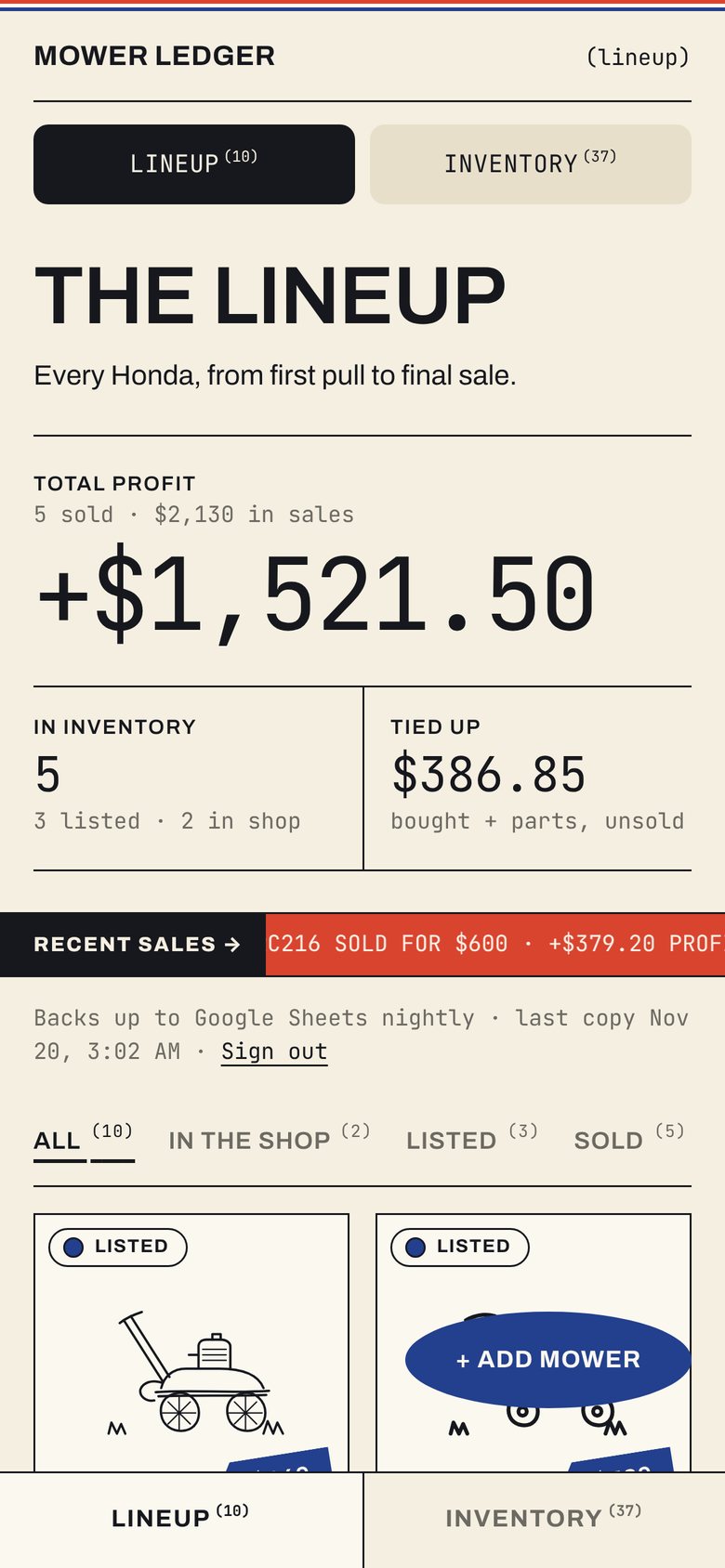
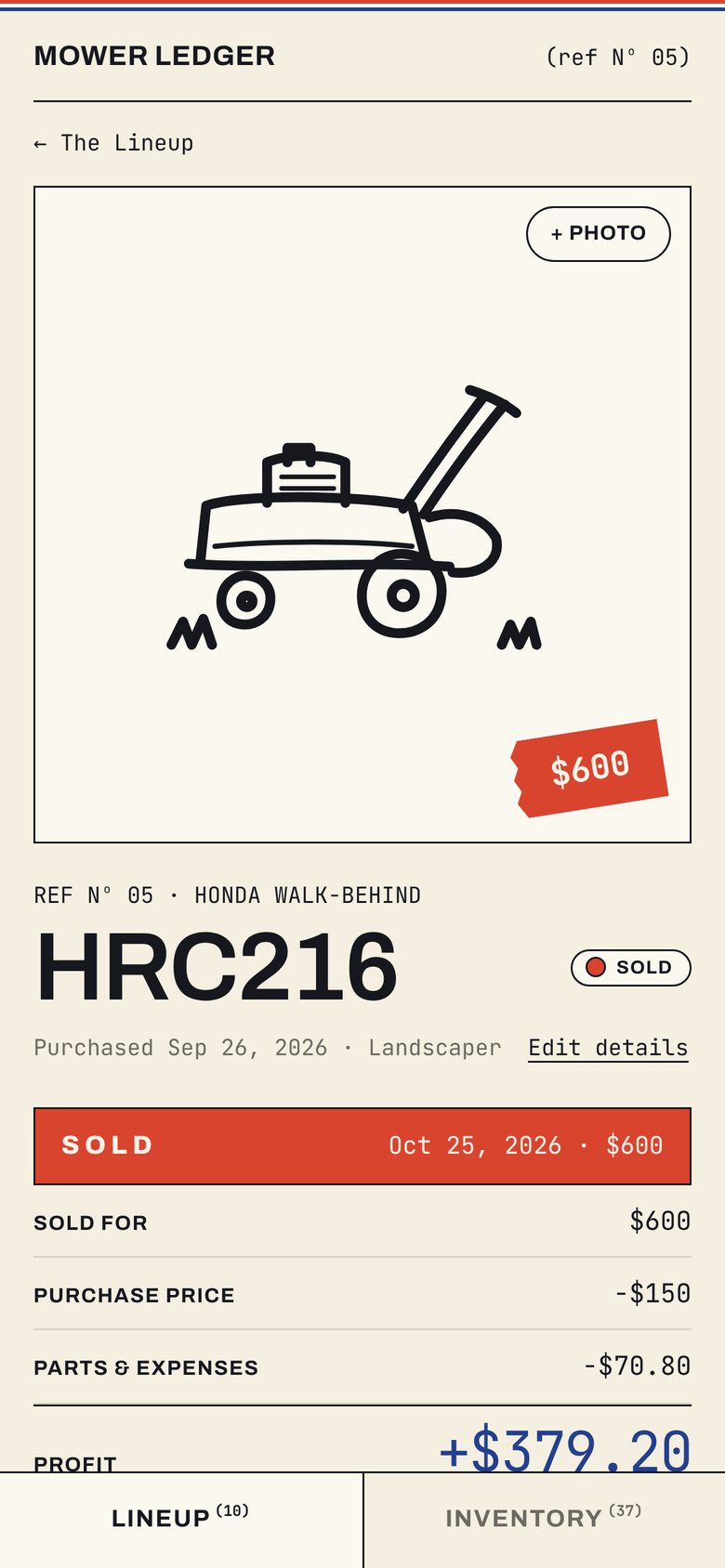
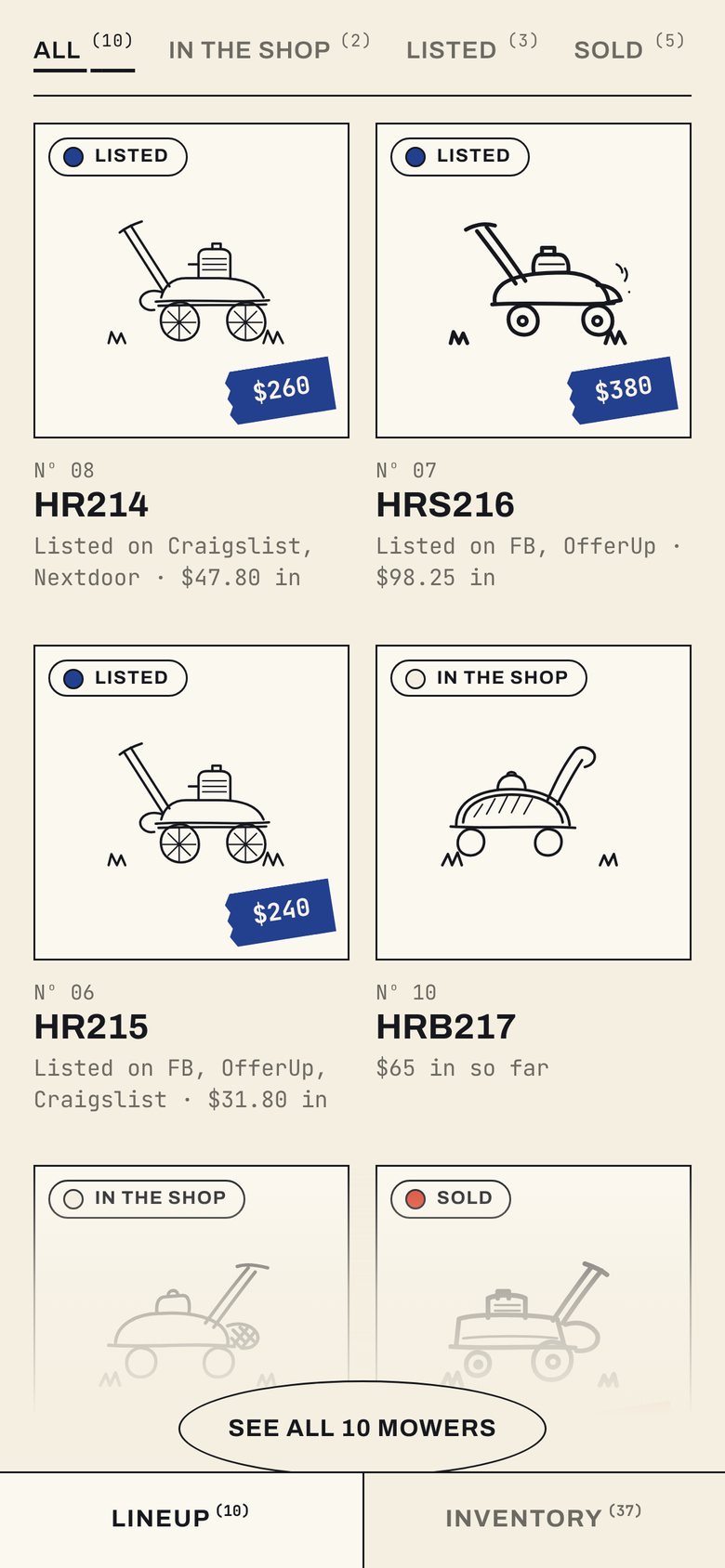
The home screen opens on total profit, then mowers in inventory and the money tied up in them. Below is a gallery of every mower, filterable by in the shop, listed and sold. It shows four at a time, with the next two fading under a "See all" button, so records and the books stay close however long the lineup gets. Each carries a model number in order of purchase and a price-gun sticker: blue for the asking price, red once sold.
Intake
A photo, the model, purchase price, date, where it came from, and its condition at purchase, picked from one-tap chips like "won't start" or "bag torn."
Work that asks about cost
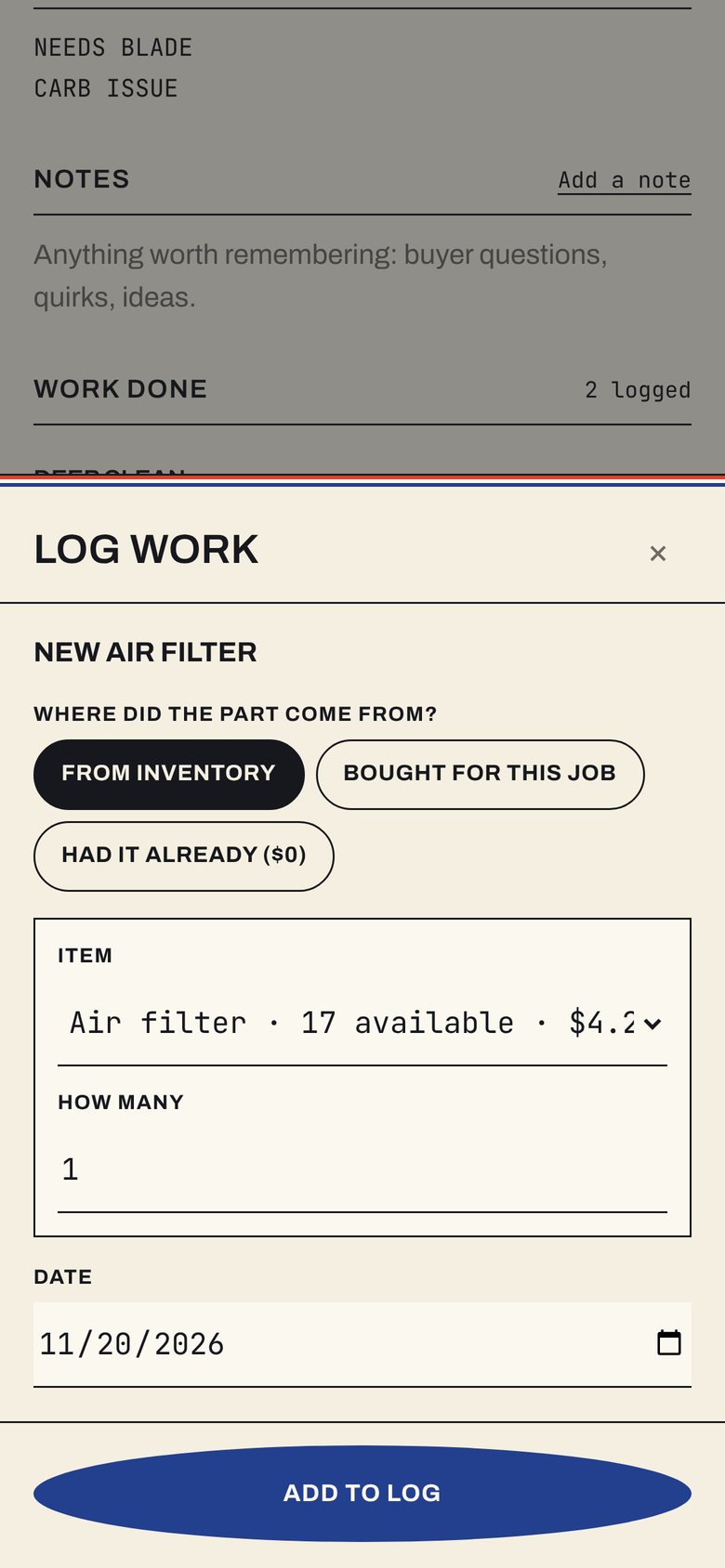
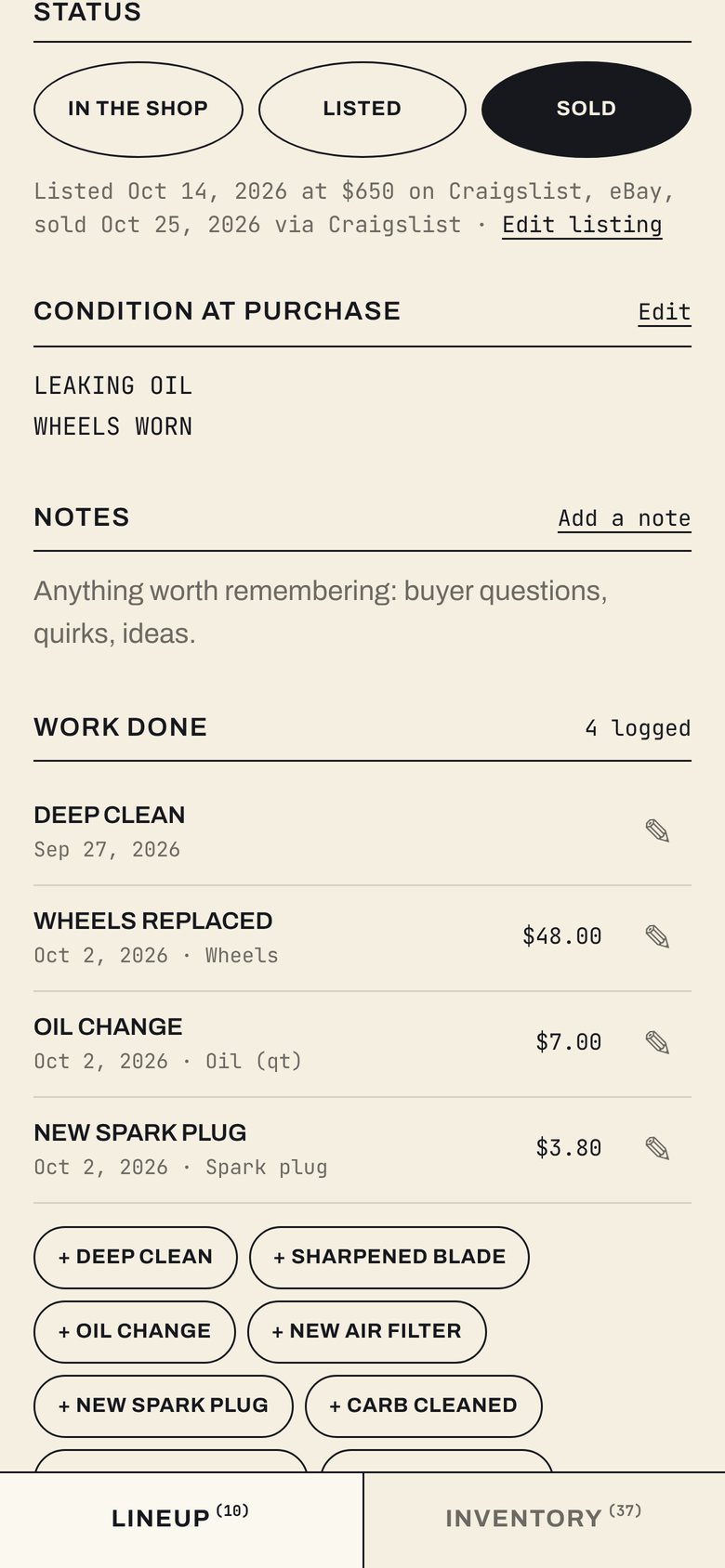
Common jobs are one tap. Anything that replaces a part asks where the part came from: from inventory (charged at per-piece cost and taken off the shelf count), bought for this job (enter what it cost), or already on hand ($0). Any job can be back-dated, and its cost moves with it.
Listing and selling
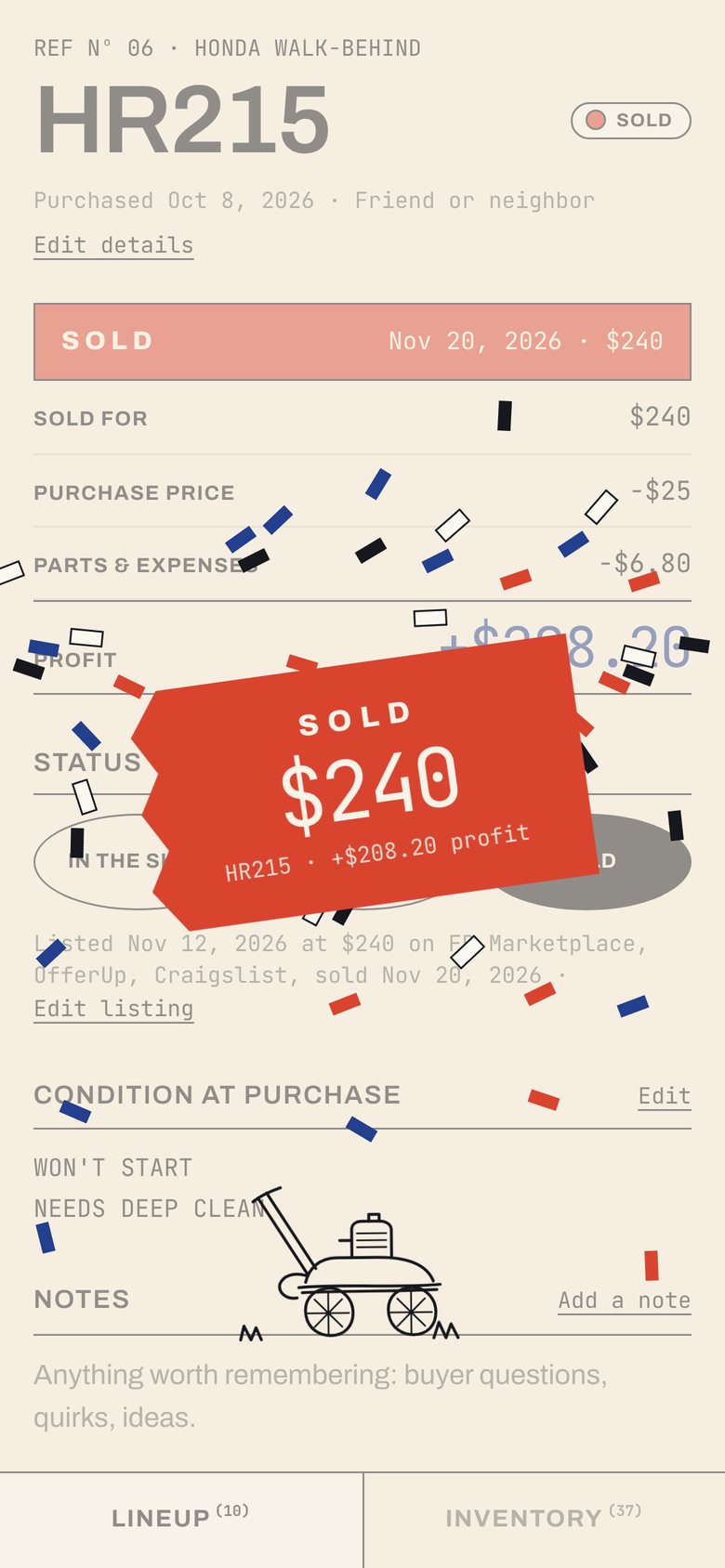
Listing records the asking price, the sites it's on (FB Marketplace, OfferUp, Craigslist and others) and the profit at that price. Selling records the price, date and which site it sold through, then shows sale price minus purchase price minus everything charged to it.
Inventory
Everything on the shelf, entered by the pack or by the piece, with on-hand and used counts that update as jobs use parts. "Add more" restocks an item.
The books
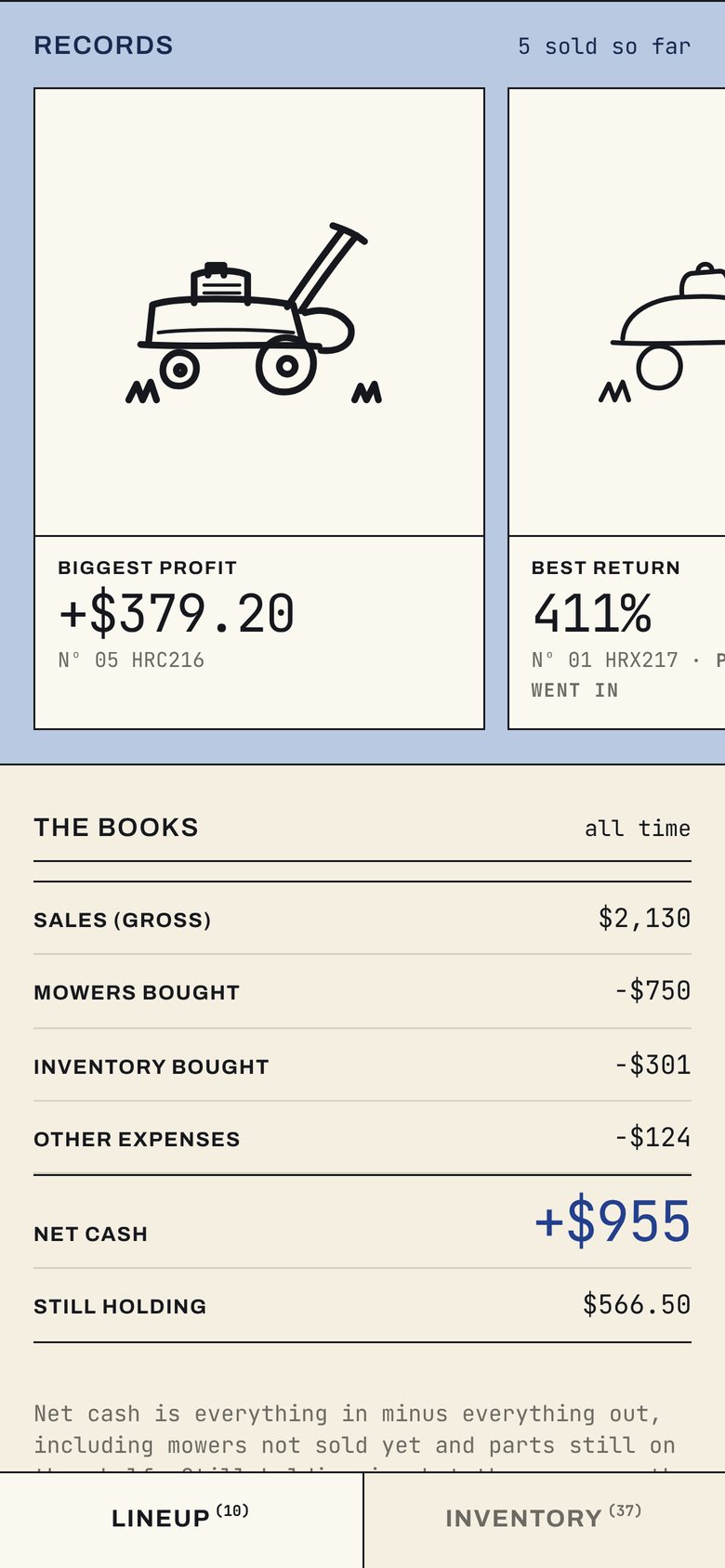
Gross sales, minus every mower bought, every part bought and every other expense, equals net cash. Beside it, "still holding" shows what unsold mowers and shelf parts are worth at cost, so an early negative reads as investment, not loss.
Records
Once there's enough history, the app crowns its own superlatives: biggest profit, best return, quickest flip, the big project, steal of a deal and longest in the shop.
How it's built
The whole stack runs on free plans with no build step, with costs flagged before anything is added.
Claude
Product partner for the data model, design directions and code: prototyping, writing and committing the app, and testing each change against sample data before it shipped.
GitHub and Vercel
Version control and hosting. Every change pushed to GitHub redeploys the live app in about a minute.
Supabase
The database and photo storage, syncing live between phones. Only emails on an allowed list can read or write, and that rule is enforced by the database itself, not just the screen.
Google sign-in
One tap to get in, with no new account to make.
Google Sheets backup
A script in a Google Sheet he owns copies the whole ledger every night into Summary, Mowers, Inventory and Expenses tabs, with no button to press. The app shows when the last copy ran. The nightly copy also keeps the free database active through the off-season.
Design direction
The humor is in taking a lawn mower completely seriously. After a luxury watch look read as too on-the-nose and a carmaker-clean look as too plain, I landed on a spec-sheet language borrowed from Japanese stationery and streetwear, where ordinary objects are labelled like collector's items.
- Paper and ink: warm cream, black hairline rules, all-caps names and monospace numbers.
- Palette: Honda racing red, white and blue, faded as if it were a diffusion line.
- Flipper details: price-gun stickers, oval buttons, superscript counts and a big clock in the footer.
- Hand-made touches: a wobbly line-drawn mower stands in for missing photos, and doodled tools hang on a pegboard around the inventory.
- One moment of joy: marking a mower sold stamps a SOLD sticker with the profit, the doodle mower drives across the screen and red, white and blue paper falls.
Decisions along the way
Prototype first
I validated the data model as a Claude artifact in about an hour. When the requirement became "no extra accounts to use it," I moved it to GitHub, Vercel and Supabase, still free.
Capture cost at the moment of work
Logging the job is where the part gets charged, so costs never depend on remembering a receipt later.
Two kinds of money
Profit per sale answers "was that one worth it." Net cash and still holding answer "is the hobby paying for itself."
Write it for the user
Early labels were written about him ("when he got it"). He's the one using it, so they became "condition at purchase" and "purchase price."
Records that earn it
With one mower, it won every record by default. Records now wait for a few flips, and "steal of a deal" became the best sale-to-purchase multiple rather than the cheapest buy.
What's next
- Before and after: a second photo and a one-line story for each mower.
- A scrapbook: every flip, collected.
Try the demoOpen the live app (private, sign-in required)
The same method as the civics app and Hintlist: find the real problem under the stated one, write the rules down precisely, and test what you built against how a real person uses it.